
Licking County Court Records After Arrest
The arrest-to-court path in Licking County starts with jail booking, then moves to prosecutor review, clerk filing, and court events. The active jail roster may show a booking charge and disposition string such as warrant, field arrest, indictment served, no charges filed, not guilty plea, awaiting arraignment, awaiting trial, probation violation holder, or holder warrant. Those entries are useful leads. They are not the final court record.
For custody and booking detail, use Licking County jail inmate records. For booking-photo questions, use the Licking County jail mugshots page. Court records after a Licking County arrest are the case records created or updated when a prosecutor, law director, clerk, judge, or court takes action on the charge.
Licking County Felony Court Records
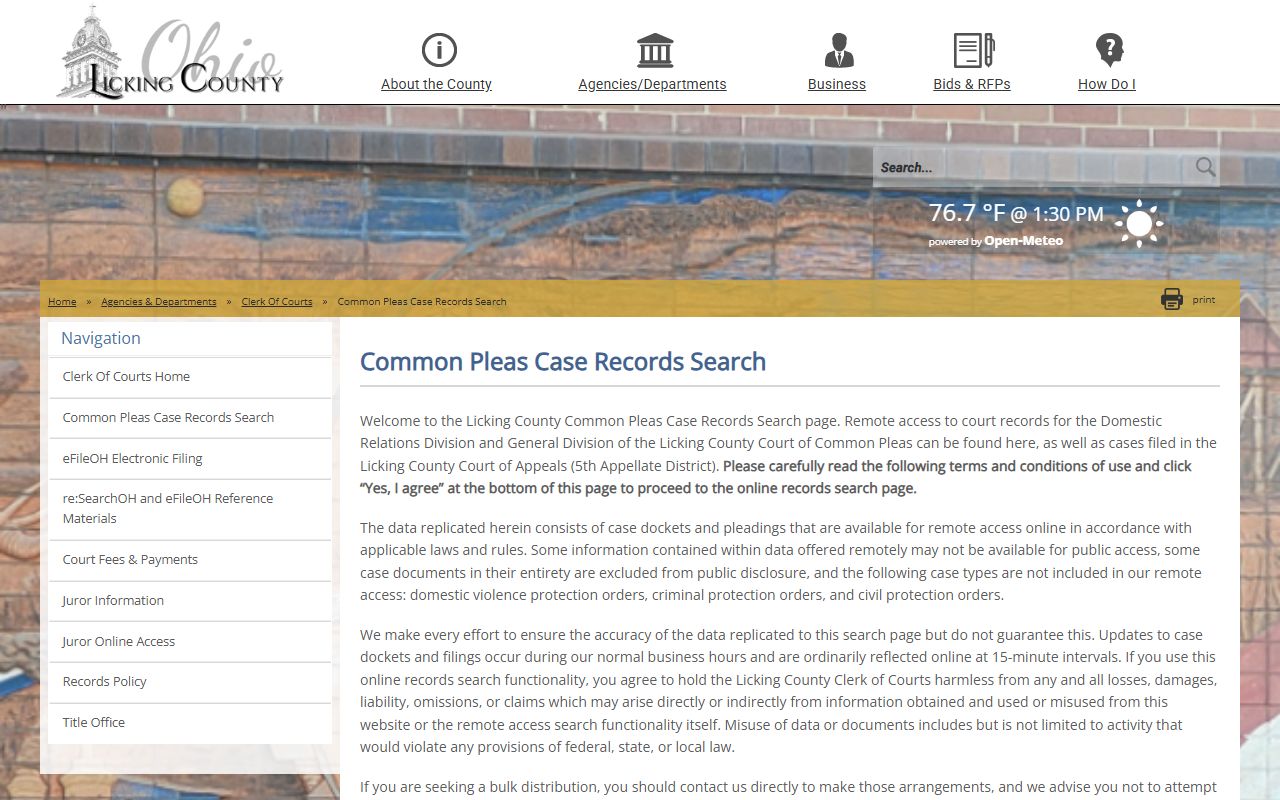
The Licking County Clerk of Courts page says the Common Pleas Clerk migrated to a new case management system in June 2025. It also says the Common Pleas Case Records Search gives remote access for Domestic Relations Division, General Division, and Fifth District Court of Appeals cases filed in Licking County. New records are updated during normal business hours and are ordinarily reflected online at 15-minute intervals, according to the official terms page.
The Common Pleas records-search terms page is the official entry point for those felony and higher-court records.
Use the clerk's record for filed case events and certified-copy routing, because a roster charge can change once the court record is opened.
- Copy the exact defendant name, docket number, charge text, booking number, and in-date from the jail roster.
- If the docket uses a felony Common Pleas style such as 26CR, check the Common Pleas Clerk search.
- Open the case record and compare the defendant name, charge, filing date, and case status.
- Contact the Clerk for certified copies instead of relying on printed website pages.
Licking County Arrest Court Records
The Licking County Municipal Court is especially important after arrests tied to misdemeanors, traffic, OVI, and early lower-court appearances. Its records and online payments portal is linked from the court's official homepage. Search snippets for the portal showed case number, driver's license, party name, and business name fields, with a case-number format such as a four-digit year, two alphabetic characters, and five digits.
| Court Path | Common Use | Where to Search |
|---|---|---|
| Common Pleas General Division | Adult felony cases, felony indictments, felony pleas, and many post-arrest felony records | Licking County Clerk of Courts records search |
| Municipal Court | Misdemeanor, traffic, OVI, and many initial criminal appearances | Municipal Court records search / online payments portal |
| Clerk certified copies | Certified case records and official copies | Clerk office, not a screenshot or roster printout |
When the roster shows a misdemeanor or traffic-style docket such as CRB, TRD, or TRC, the Municipal Court search is often the better first court stop. When the roster shows TBS or awaiting a bond hearing, a case may not yet be visible online.
Charges Filed After Arrest
The Licking County Prosecutor's Office is led by Prosecutor Jenny Wells and handles adult felony prosecution. The official page says the Adult Felony Division prosecutes adults charged with felonies under Ohio law and juveniles bound over for adult prosecution. It also says most adult felony case status can usually be determined through the Common Pleas Clerk of Courts database.
Adult misdemeanor prosecution is different. The prosecutor's page says the county prosecutor generally does not prosecute adult misdemeanors. The Newark Law Director's Criminal Division prosecutes misdemeanor, criminal, and traffic matters for Newark, Heath, Pataskala, Granville, Reynoldsburg in Licking County, New Albany in Licking County, and unincorporated Licking County. That is why court records after a Licking County jail arrest may split between Common Pleas and Municipal Court.
Licking County Charging Documents
A charge can start one way and change as the case moves. The roster may reflect the officer's arrest language, a warrant, or an initial court event. The formal case record may later show a complaint, information, or indictment. These terms should be read as document types, not proof of conviction.
| Document | Plain Meaning | Common Use |
|---|---|---|
| Complaint | A charging document often used to start a case before indictment or in lower court. | Misdemeanors, traffic, or early felony-stage records. |
| Information | A formal prosecutor charging document used in some felony cases without grand-jury indictment under legal conditions. | Felony cases when legally allowed. |
| Indictment | A grand-jury charging document for felony prosecution. | Serious felony matters and cases after grand-jury action. |
Licking County Charge Status
Charge status is the reason the court record matters after an arrest. A booking charge can be pending at intake, amended by the prosecutor, reduced through negotiation, dismissed, or replaced by an indictment. The court docket controls the current formal case status. The roster remains useful for custody, bond, and jail status, but it should not be treated as the final charging document.
| Status | What It Means |
|---|---|
| Pending | The charge or case remains open. |
| Amended | The prosecutor or court changed the charge. |
| Reduced | The charge was lowered to a lesser offense. |
| Dismissed | The charge ended without conviction on that count. |
| Nolle prosequi | The prosecutor declined further prosecution of a charge. |
| Conviction | A final guilty plea or finding on a charge. |
Licking County Arrest Bond Records
The Licking County roster embeds bond language in disposition strings. Examples found in the research include cash/surety bonds, 10 percent bond language, OR bond, awaiting Common Pleas bond hearing, awaiting first bond hearing, and no-charges-filed release language. The court sets bond. The jail processes custody and release after valid paperwork, payment, or conditions are satisfied.
| Bond Term | How It Works |
|---|---|
| OR bond | Own-recognizance release based on a promise to appear, sometimes with conditions. |
| Cash bond | Money posted directly with the court or jail as security. |
| Surety bond | Bond posted through a surety or bail agent. |
| 10 percent bond | Deposit-style bond language recognized in Ohio bail law and observed on roster entries. |
| No-bond or holder status | A parole hold, outside warrant, federal hold, ICE detainer, or pickup order can block release. |
No official local bond payment schedule was located in the jail pages reviewed. Call the Jail Division at 740-670-5501 or the court shown on the docket before traveling with payment.
Licking County Warrant Arrest Records
No official Licking County Sheriff's active public warrant database was located in the official sources reviewed. Once a warrant leads to booking, the jail roster may show warrant-related status text such as warrant, bench warrant, failure to appear, capias, probation violation holder, or holder warrant. Court records can also show warrant events tied to the case.
For warrant-related court records after a Licking County arrest, check the Common Pleas or Municipal Court docket that matches the case number. If a person believes a warrant exists, the safer route is to contact the issuing court or an attorney and confirm whether bond is set and where surrender must occur. The county and Municipal Court also warn about jury-duty scams; official pages say the Sheriff's Department does not issue warrants for jury service and the court does not request jury-service payment.
Charges vs Convictions
A charge is an accusation in a criminal case. A conviction is a final result after a plea or finding of guilt. Court records after a jail arrest may include both, but they should not be collapsed into one idea. A roster charge can appear before prosecutor review, and a court charge can later be dismissed or amended.
| Charge | Conviction | |
|---|---|---|
| Stage | Accusation or filed count | Final guilty plea or finding |
| Where It Appears | Roster, complaint, information, indictment, or docket | Court docket and judgment entries |
| Can Change | Yes, through amendment, reduction, dismissal, or indictment | Only through court action such as appeal, vacation, sealing, or expungement where eligible |
Sealed or Expunged Records
Ohio Revised Code 2953.32 governs sealing and expungement for eligible records. Sealing generally hides a record from ordinary public view while preserving limited access for specific legal purposes. Expungement is narrower and can involve destruction or deletion where the law allows it. Eligibility depends on the case, offense, disposition, waiting period, and court order.
| Sealed | Expunged | |
|---|---|---|
| Public visibility | Hidden from most public searches after court order | Treated as removed or destroyed where Ohio law allows |
| Agency access | Some agencies may retain limited access | More limited after a valid expungement order |
| How it happens | Eligible person files in court and receives an order | Eligible person files under applicable Ohio law and receives an order |
Important: This site is not a consumer reporting agency and cannot be used for employment, housing, credit, or insurance screening.
Licking County Court Access Limits
The Common Pleas search terms page states that some information may not be available remotely, some documents are excluded from disclosure, and domestic violence protection orders, criminal protection orders, and civil protection orders are not included in remote access. Juvenile matters, sealed records, confidential law-enforcement investigatory records, medical records, victim information, and other protected records can also be limited under Ohio or federal law.
For certified copies or error corrections, use the Clerk rather than a third-party copy. For current custody, use the jail. For recent sheriff records, use Civil/Records. Keeping those custodians separate prevents a common mistake: asking the jail for a certified court docket or asking the court to confirm a real-time jail release.